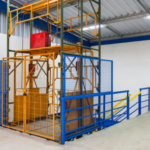
Industrial elevators
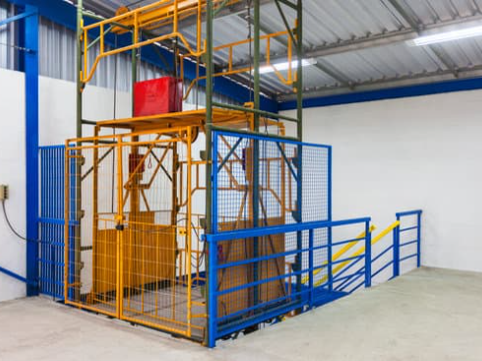
Industrial elevators and lifts, freight elevators, rack-and-pinion lifts, personnel hoists, and mast climbing platforms, require braking systems
that engage instantly and hold reliably when power is lost. A brake failure in a lifting application is not a performance issue: it is a safety incident. This is why elevator safety brakes must be spring-applied and electrically released, not the other way around.
EIDE manufactures and supplies safety brakes, electromagnetic brakes, and centrifugal overspeed brakes for industrial elevator applications. Our components are installed in elevator drives across Europe, Latin America, and Asia, in both standard and ATEX-certified configurations.

Safety brakes for industrial elevators and lifts
The primary safety requirement in any industrial elevator is a fail-safe brake: one that is mechanically closed at rest and opens only when power is applied. If the power supply is cut, by a fault, an emergency stop, or a planned shutdown, the brake engages automatically without any control signal.
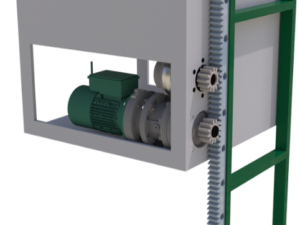
EIDE’s FPC safety brake (parachute brake) is the standard solution for rack-and-pinion industrial elevators and mast climbers. The FPC is a spring-applied, electrically released brake that clamps directly onto the rack or drive shaft. It is certified ATEX (II 2G IIC T6 Gb, notified body LOM, number 0163) for use in potentially explosive environments such as petrochemical plants and offshore platforms.
Key FPC specifications for elevator applications:
- Braking torque: 500 to 6,000 Nm (FPC-500 to FPC-6000)
- Operation: spring-applied, 180VDC or 205VDC electrically released
- Certification: ATEX II 2G IIC T6 Gb · EN ISO 80079-36
- Mounting: dual-shaft configuration for simultaneous engagement on both sides of the drive unit
→ FPC safety brake technical datasheet
Overspeed brakes for elevator drives: DBQ and EC centrifugal brakes
In addition to the primary safety brake, many industrial elevator applications require an overspeed brake, a device that engages automatically if the elevator exceeds a set speed, regardless of the control system status.
EIDE’s DBQ and EC centrifugal brakes engage by centrifugal force when rotational speed exceeds the preset threshold. They require no electrical signal and no control input: the physics of the rotating mass triggers engagement. This makes them a fully independent safety layer from the primary electrical brake system.
The FPC and DBQ can be mounted on the same drive unit, providing two independent braking mechanisms: the FPC for controlled stops and power failure, the DBQ for overspeed protection.
Electromagnetic brakes for elevator motor drives
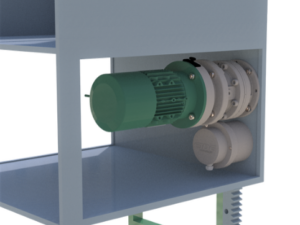
Beyond safety braking, elevator drive motors use electromagnetic brakes for holding torque when the motor is de-energised, preventing the load from moving during loading, unloading, or standby. EIDE supplies several electromagnetic brake series for this function:
- FDB spring-applied electromagnetic brake: spring-closed, electrically opened. Used as a motor holding brake on elevator drive motors. Mounts directly to motor flange.
- FDW electromagnetic brake: same fail-safe principle, different mounting geometry for specific motor configurations.
- FAE/M electromagnetic brake: current-operated (positive) brake for applications where braking is required only when energised.
- FLC electromagnetic brake: compact design for space-constrained motor installations.
Pneumatic brakes for heavy-duty elevator applications
For industrial elevators handling heavy loads at low speeds, such as freight hoists in steelworks, mining, or shipyards, pneumatic brakes provide high braking torque with simple actuation. EIDE’s FNA and FNAM pneumatic brake series are spring-applied, pneumatically released disc brakes suitable for large-diameter shafts and high-torque requirements.
EIDE brake products for industrial elevators:
For more information about the products that we have at EIDE, do not hesitate to contact us.